
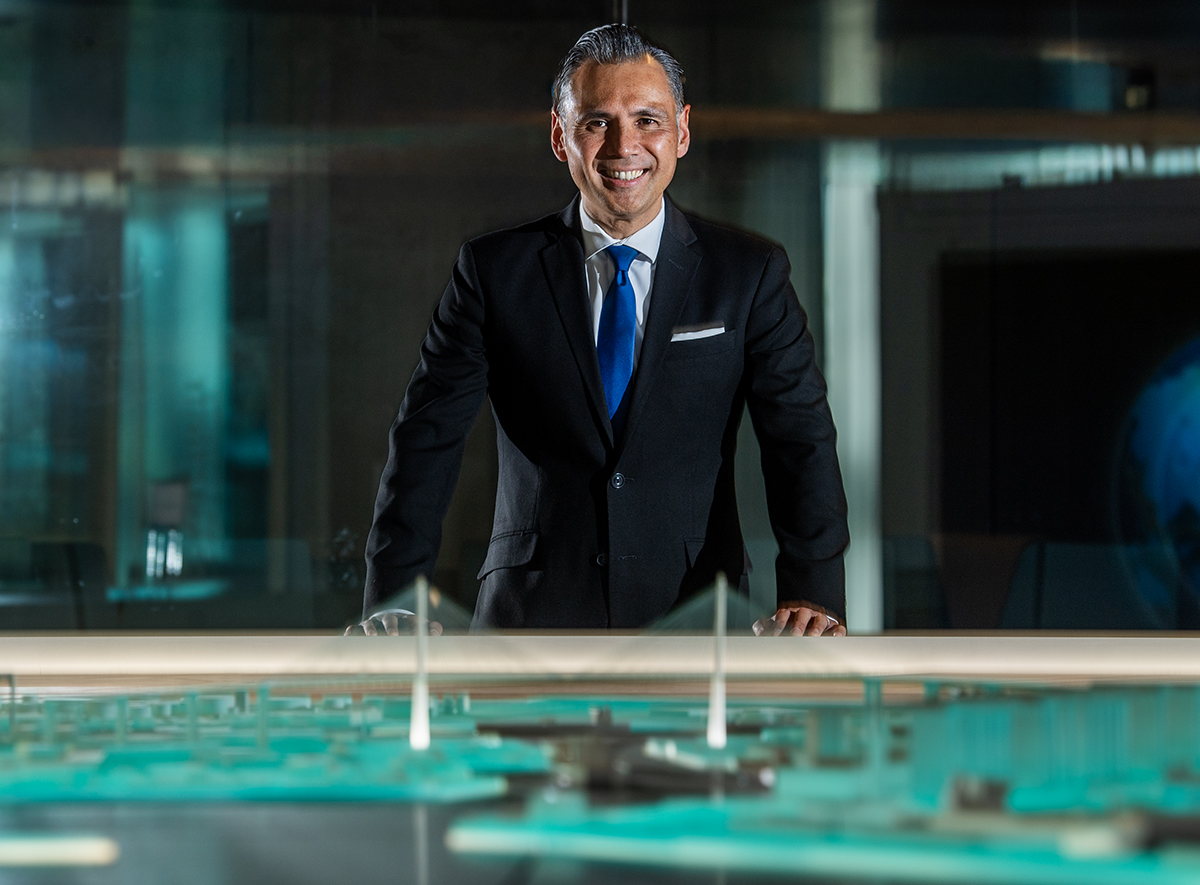

For 8 ½ years, the Port of Long Beach has been led by an aficionado of classical music who saw to it that the sounds of Gershwin, Aaron Copland and Etta James filled the hall when hundreds gathered for the port’s annual presentation to city leaders.
Now a new guy is in charge, and he’s more rock and roll.
In his introduction for his State of the Port speech in January, new CEO Noel Hacegaba came out swinging his Gibson Les Paul ’50s electric guitar. The opening video featured Hacegaba fronting for a group of port-employed musicians called “The TEUs” — a play off a container measurement in shipping — with shots of the port’s cranes and ships in the background. After the video finished, Hacegaba strolled out, his silhouette visible, rock–star style, as he was bathed in smoke and blue light. It was fun to watch and more than a little over the top.
“That’s the part about him that makes people feel relaxed,” said Frank Colonna, president of the Long Beach Board of Harbor Commissioners. “He’s not plastic. What you see is what you get.”
Mario Cordero, the classical pianist who retired as CEO last year, was “more of a baseball guy and I’m more of a football guy,” Hacegaba said. Where Cordero, who oversaw the Green Port initiatives as well as record influxes of cargo during and after the pandemic, was seen as genial, accessible and largely uninterested in the spotlight, Hacegaba brings the urgency of a quarterback facing fourth down and no timeouts.
Hacegaba’s game plan involves doubling capacity at the port — moving from 9.9 million 20-foot container units (TEUs) in 2025, a record, to 20 million by 2050. It also means demonstrating that the Port of Long Beach is a player in the shipping world, as Hacegaba flew to Davos, Switzerland, in January to speak at the World Economic Forum, the only representative from a U.S. port.
“2050 is the new goal line,” said Hacegaba in an interview at the Port of Long Beach offices. He talks urgently about the need to “expand our playbook,” and “update our game plan and move to a hurry-up offense … because 24 years may sound like a long time, but in our world, when you’re delivering infrastructure, when you’re navigating fundamental changes and realignments and global trade, 24 years is not a long time.”

Hacegaba speaks with the confidence and vocal projection of a seasoned preacher. He is the pastor of Calvary Baptist Church in La Puente. It’s a part-time job to which he devotes his Sundays.
“To me, everything I do is a form of service,” he said. “When I’m at work I serve my team, I serve my customers, my stakeholders. Having that perspective, that fulfillment, energizes me.”
On a recent Sunday soon after the new year, Hacegaba spoke to his congregation on the finite nature of time, moving smoothly between English and Spanish: “Each of us gets the same amount of time every day,” he said. “Even if you buy a watch that costs you $10,000, that expensive watch isn’t going to give you a second more.”
Hacegaba, 49, who lives in East Long Beach with his wife and two daughters, calls time a precious commodity and he meters it carefully. He rises about 4:30 every morning to work out and enjoy quiet time and set priorities for his day. He said he was always governed by discipline and credited his parents with instilling it.
Hacegaba’s great-grandfather was Japanese, and he and a friend agreed to sail to the U.S. after World War I. Somehow they ended up in Mexico. A clerk at immigration there mistakenly changed the family name from Hacegawa to Hacegaba, and it has stayed that way for generations.
The L.A. native grew up in Baldwin Park and often spent Friday nights eating burgers at Southern California’s first In-N-Out there. He grew up watching Marcus Allen and Bo Jackson play for the Raiders and dreamed of being a scientist like Jacques Cousteau. Then he switched his sights to engineering and eventually business and economics.
His first language was Spanish and his parents, who came from Mexicali, worked in manufacturing and never finished high school. But they encouraged him to get an education. He got a full ride to USC and earned two undergraduate degrees and two master’s before getting his doctorate in public administration from the University of LaVerne.
“My parents, because they didn’t have the benefit of an education … it was their desire for their children to pursue higher education.” He was the first in his family to graduate from college.
The longtime Raiders fan is committed to his hurry-up offense even with trade uncertainty swirling around the port, the second-largest in the U.S. next to the Port of Los Angeles.
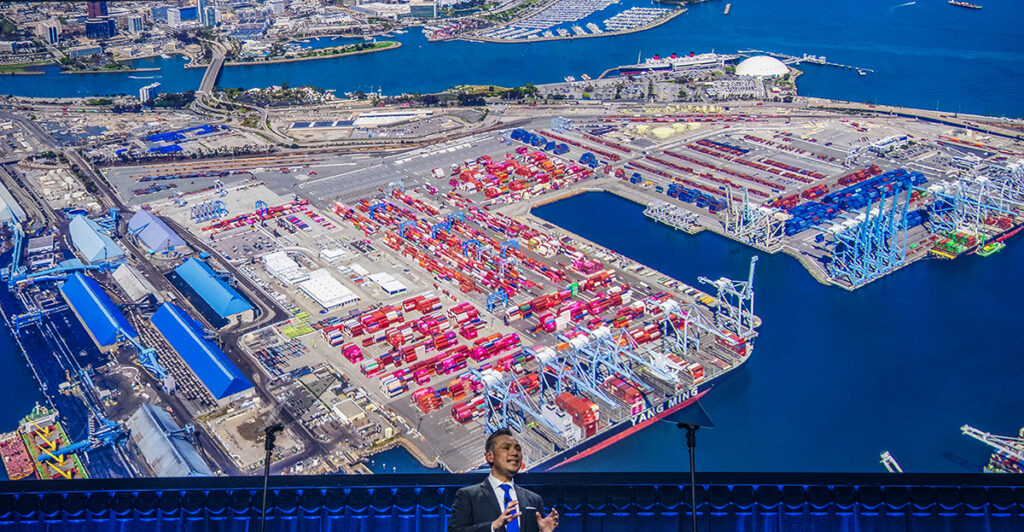
That means spending $3.2 billion on improving infrastructure with help from federal grant money, a project launched by his predecessor. The Pier B On-Dock Rail Support Facility, slated for completion in 2032, is designed to help move goods directly to trains and send those trains to distribution centers all over the country. It takes just under four days to unload a container, log it in and put it on a train. Hacegaba wants to trim that time to 24 hours.
“To be more competitive, we need to be faster, right?” he said. “Because what’s the competitive advantage in supply chain goods movement? It’s speed to market.” He plans to invest in digital tools such as CargoNav that will help track goods in real time. He believes the rail project will facilitate quicker goods movement, getting goods right onto trains and trimming the number of polluting trucks chugging up the 710 Freeway.
“We’re located on the West Coast of the U.S., but only a third of all of our containers stay here,” Hacegaba said. “Two-thirds of the containers that arrive here end up east of the Mississippi. So … the way we beat the competition … is by moving containers from Long Beach to all of these key inland markets as quickly as possible, faster than Savannah, faster than New York, New Jersey.”
The Long Beach port and other West Coast ports are facing “headwinds,” said John McCown, author of the McCown Report that tracks shipping trends in the top 10 ports. Improvement in goods movement over recent years favors East Coast ports that are closer to U.S. population centers and the Midwest. East Coast ports are closer to 75% of higher population centers as opposed to 25% for the West Coast ports. The widening of the Panama Canal in 2016 made it easier to move goods from Asia to ports in the eastern and Gulf states.
Another challenge is that the Port of Long Beach has a 4:1 trade deficit, meaning four times as many loaded containers sail in than sail out, which makes it less attractive as a destination port, McCown said, because it’s seen as less efficient. The largest container growth area for the port last year was in empties outbound and inbound, at 6.7% and 5.8%, respectively.
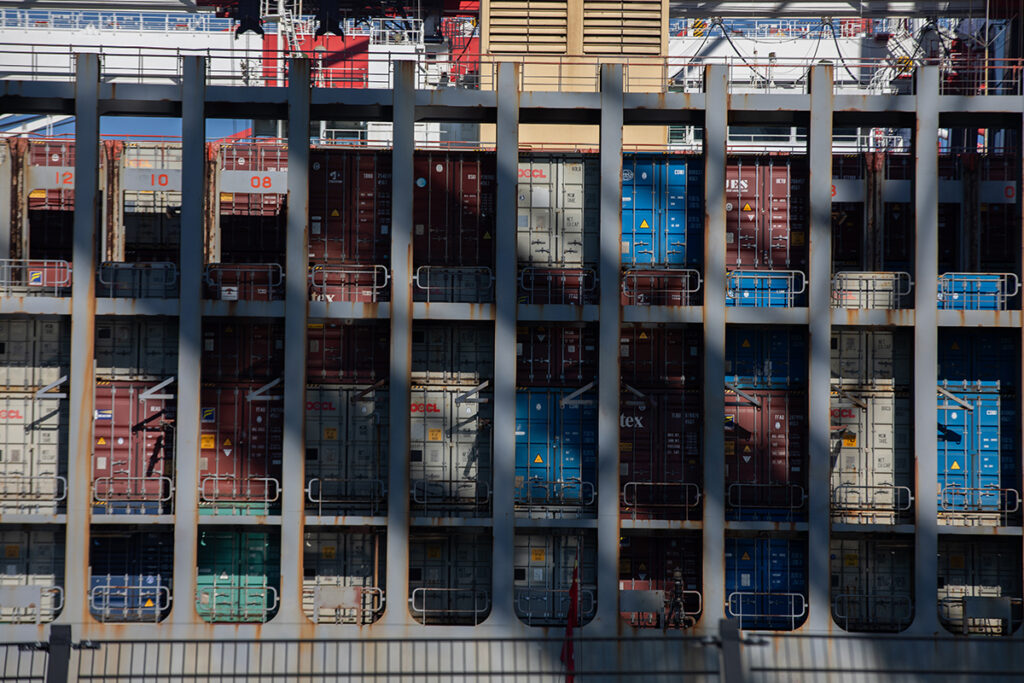
That reality infuses Hacegaba’s evangelizing for port expansion. “Part of updating our playbook” means identifying new and emerging markets such as Latin America and the Indian subcontinent, he said. More than 90% of the port’s shipments currently come from East Asian countries.
Hacegaba wants the world to know the port is going big, thinking big, trade uncertainty be damned.
A chance encounter prompted Hacegaba’s move from waste movement to goods movement. As director of municipal services with Republic Services, a waste disposal company, he decided to attend a State of the Long Beach Port event 15 years ago.
“One of my assignments … was to promote the company in Long Beach. I lived in Long Beach, I worked in Long Beach. And so I started attending events in Long Beach, and one of the events that I attended was the state of the port,” Hacegaba said. “I bought my ticket online. I showed up the day of the event, I checked in, got my seating assignment, went to the table, and every seat was taken. So either someone took my seat or there was a mishap. … The only seats available were at the tables way in the end, right next to the exit door. So I said, this is perfect. I can sneak out a little early.”
Hacegaba found himself chatting with the port’s director of HR, who asked for his business card. Ten days later he got a letter with a job announcement from the port. He thought executive director to the board of harbor commissioners sounded like “a cool job.” He started in 2010.
Mario Cordero, the outgoing port CEO who interviewed Hacegaba 15 years ago, said Hacegaba came across as a fast learner who had “equanimity in his demeanor.” Cordero pointed to the new CEO as he was being congratulated on the dais after his State of the Port presentation. “He dressed then as he does now — professional.” Hacegaba grew to become Cordero’s “No. 2” guy and confidant. When Hacegaba became COO, he was on his way to the top job.
Hacegaba’s move to the port “wasn’t planned. It wasn’t something I was looking for,” said Hacegaba. “It was what I call providential. And here I am, almost 16 years later, having the time of my life and just enjoying every challenge and every moment.”

Those moments have to include reacting to uncertainty. He recalls when Donald Trump was re-elected, some in his field were saying they’d “seen this movie before” regarding 2018 tariffs imposed against China, leading to a dive in the stock market and other repercussions during Trump’s first term. “What we saw unfold (in 2025) was not a rerun, and it was not a sequel. What we saw unfold was sweeping and unprecedented.” The start of the year featured talk that Trump would levy more tariffs against Europe before apparently changing his mind in January. Trump levied an array of tariffs in 2025.
There’s also the ongoing reality of port air pollution. While pollution has decreased markedly since 2005, the ports of Long Beach and L.A. are still the biggest fixed source polluters in the L.A. basin.
The implementation of state air regulations helped force changes to cleaner trucks. The Clean Air Action Plans at the ports of L.A. and Long Beach have helped improve air around the port, said Sarah Rees, deputy executive officer for planning rule development and implementation for the South Coast Air Quality Management District. AQMD last year reached an agreement with the ports to reduce pollution by 2029. “A lot has been done. … There’s still a long way to go because that huge port complex, L.A. and Long Beach is still a major polluter and still affecting the surrounding neighborhoods.”
The Port of Long Beach alone moves almost one-fifth of the country’s cargo and supports 691,000 Southern California jobs. About 20,000 people work at the 3,520-acre port complex. The Long Beach and L.A. ports together move roughly 40% of all U.S. container imports.
The move to trains, to faster goods movement, plays into the Green Port plan and Hacegaba’s expansionist vision. Like a coach preparing for the season, Hacegaba seems driven to boost his team’s stats and show the shipping world the Port of Long Beach projects strength and energy.
“You know what [legendary coach] Vince Lombardi once said, ‘I’ve never lost a football game. I just ran out of time.” Hacegaba said. “We are shifting to a hurry-up offense to win, because we play to win here. I don’t want us to run out of time.”